


Hofmann: the myth of the compact, powerful speaker with deep bass
Want a compact, high-sensitivity loudspeaker that can go below 30 Hz? Bad news: Hofmann’s law says that’s impossible. Here’s why – and more importantly, what that means for today’s designers, brands, and audio projects.
ARTICLES
Clement R.
12/2/20253 min read
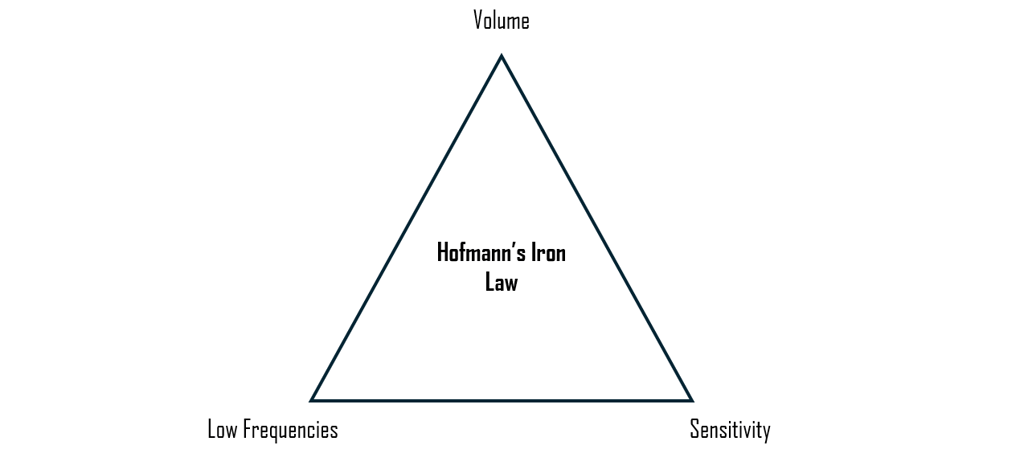
Hofmann’s Law: The Non-Compressible Trade-Off of Audio
In many audio projects, the initial request looks like this:
“We want a small enclosure.”
“But with very deep low-frequency extension.”
“And ideally good sensitivity.”
And every time, I have to say the same thing:
Physics does not allow that specification.
You can’t have all three.
That is exactly what Hofmann’s Law, also called The Iron Law in acoustics, states.
Why does this law exist?
Because a loudspeaker is not a miracle machine.
Its behavior depends on two very down-to-earth factors:
The air it needs to move (air volume)
To produce bass, you need to move a lot of air.
And in a small enclosure, the air is “stiffer,” the compliance is low.
The driver has to work harder → larger excursion → more distortion → lower efficiency.
The natural electroacoustic efficiency of a loudspeaker
A highly efficient speaker usually has:
a strong motor (high BL)
a light diaphragm
a stiff suspension
Exactly the opposite of what you optimize for low-frequency extension.
So when you want a driver to reach deep bass in a very small enclosure, you’re fighting the physics of the transducer.
How has the industry “bridged the gap” (on the surface)?
Today, many products seem to defy Hofmann:
small speakers that hit 40 Hz
very compact soundbars
portable speakers with “12h battery life + insane bass”
large excursions with low distortion
DSP that boosts bass without destroying the system
Except that behind the marketing magic, here’s what actually compensates:
Aggressive DSP: LF boost, dynamic filtering, adaptive loudness
Powerful class-D amps: Electricity is basically free; we put 200 W in a 3-liter box
Modern long-excursion drivers: crazy Xmax, FEM-optimized motors, tough materials
Smart limiting: prevents blowing the driver when pushed too hard
None of this removes Hofmann’s Law.
It simply pushes the limit further, at the cost of other compromises:
more distortion
reduced dynamic range
higher group delay
terrible efficiency
bass that is “impressive but artificial”
The real question: what are you optimizing for?
Hofmann’s Law forces you to choose.
And that choice depends on the product, the use case, and the audience.
Case 1: compact / lifestyle speakers
Priority: size + bass extension
Sacrifice: sensitivity
Compensation: DSP + large amplifier
This is what 99% of connected speakers and Bluetooth speakers do.
Case 2: “old-school” Hi-Fi / high efficiency
Priority: sensitivity + dynamics
Sacrifice: enclosure volume
Result: 200-liter cabinets, but what a joy.
Case 3: monitoring / pro audio
Priority: bass extension + controlled dynamics
Accept: reasonable but not tiny volume
Optimize: alignment, group delay, power response
Case 4: IoT / embedded products
Priority: ultra-low volume
Sacrifice: sensitivity + bass extension
Compensation: intelligent voicing, psychoacoustics, DSP
If you don’t make a trade-off, you just break the constraints somewhere else
If you try to force all three, here’s what happens:
The driver saturates → distortion
DSP crushes the dynamics
The amplifier overheats
The real volume no longer matches the simulation
Limiting kicks in constantly
The system sounds loud but not good
And in the end, the client is disappointed not to have an alternative physics model inside their 30 cl plastic box.
So… how do you work intelligently with Hofmann’s Law?
Clearly define priorities at the start of the project
Not at the end.
Not after the industrial design.
From the concept phase onward.
Choose a driver aligned with the goals
This is where 70% of IoT projects fail.
Accept the trade-offs, but choose them yourself
You can make it small and bassy.
You can make it sensitive and bassy.
You can make it small and sensitive.
You cannot have all three.
Use DSP & class-D as intelligent crutches
Not as miracles that abolish physics.
Conclusion: Hofmann’s Law is not a wall, it’s a compass
If you design audio systems (speakers, IoT, embedded products), Hofmann’s Law shouldn’t be seen as a restriction.
It’s a decision tool.
It simply tells you:
where you can go
what you must accept
what you need to stop promising
And above all:
it keeps you from fighting air with a screwdriver and a DSP.
At Soundfeel Lab, we help hardware, IoT, and audio teams design systems that respect, and intelligently leverage, the laws of physics.
If you have a project where bass, size, or efficiency is a challenge, we can talk.