


The limits of loudspeakers: understanding, diagnosing, and preventing damage
Discover the real limits of loudspeakers in pro audio: the differences between mechanical and thermal constraints, failure risks, the role of Xmax and AES power, common design mistakes, and solutions to prevent damage. A complete guide to protecting your loudspeakers and optimizing your speakers.
ARTICLES
12/2/20253 min read
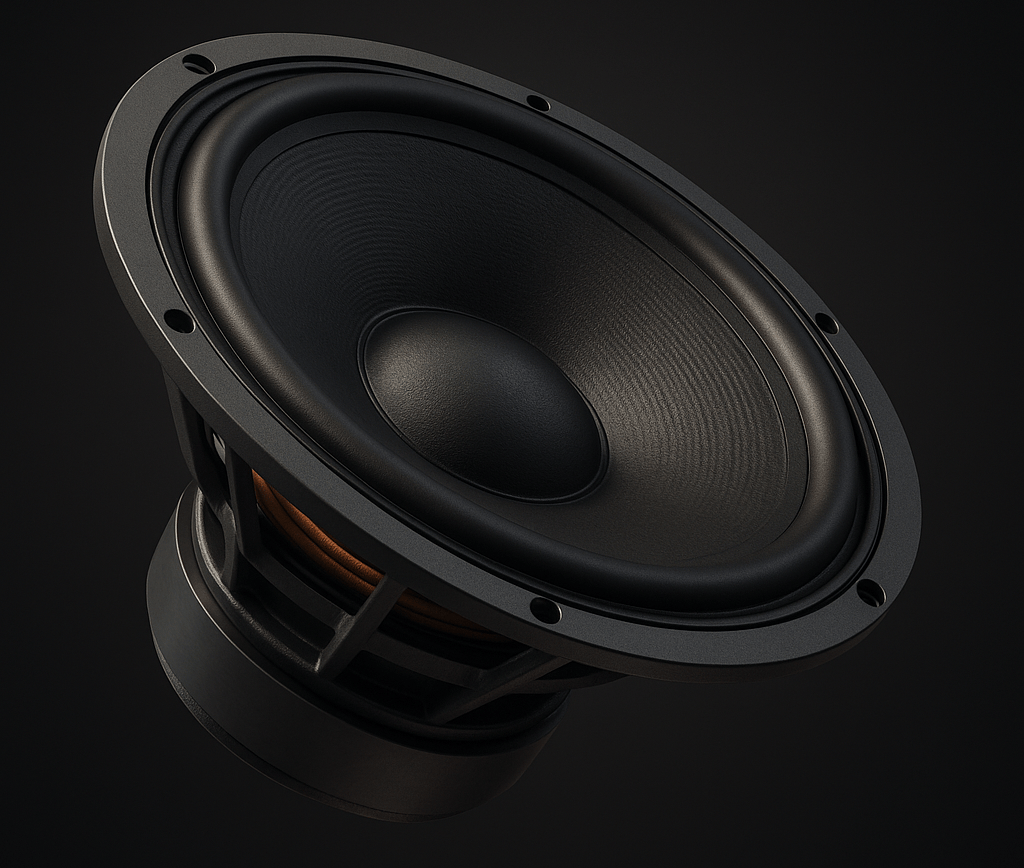
Scenario
You’re designing a subwoofer intended for demanding pro-audio use. Everything is going well, the project is progressing, and you reach the prototyping phase. Power on the amplifier, first test: everything works, perfect! As the test goes on, you turn up the volume and switch to tracks that really stress the low end. Everything is fine… until the system degrades, a small suspicious noise appears… then nothing. The loudspeaker just died.
Your first reaction: “I must have sent it too much power!”
That’s often the first instinct, but is it really the number-one reason a loudspeaker turns into a barbecue? Not necessarily…
In reality, a loudspeaker has two main limits:
a mechanical limit
a thermal limit
And these two limits behave very differently.
Mechanical limits
To produce sound, a loudspeaker moves its diaphragm.
It travels back and forth with a stroke that varies depending on the model.
Obviously, this stroke isn’t infinite: beyond a certain point, things break.
Typical mechanical failure modes:
the voice coil hitting the back plate
the suspension bottoming out on the top of the motor
diaphragm / spider / suspension tearing
Two key values define this limit:
Xmax
Maximum excursion of the moving assembly (coil, former, diaphragm, spider, suspension) for which the behavior remains linear.
Beyond this value, the driver enters a heavily nonlinear region, generating distortion and premature wear. No immediate destruction, but a clear degradation of sound quality.
Xmech
Maximum excursion before severe mechanical damage (cracks, impacts, breakage).
Very high short-term risk. A value that should never be reached.
Thermal limits
To move the diaphragm, the loudspeaker uses an electromagnetic motor made of:
a magnet (ferrite or neodymium) and pole plates creating and guiding a constant magnetic flux,
a voice coil (copper or aluminum), placed in this flux and attached to the diaphragm. This coil is connected to the amplifier.
The voltage sent into the coil interacts with the magnetic field to produce a force that pushes or pulls the diaphragm depending on the signal’s polarity and amplitude.
This coil is the thermal weak point of the system: as it receives power, it heats up and can exceed its limits, causing irreversible damage
(open circuit, coil melting, deterioration of varnish/glue/former).
The thermal limit is generally given as AES Power or continuous RMS power. These are the reference values not to exceed.
There are many marketing values that should never be used for continuous operation: “program power,” “maximum power” (without AES/RMS detail), “music power,” etc.
No RMS or AES rating? → Run.
Typical failures and their causes
Thermal failure due to exceeding power rating
The most common failure: exceeding the AES/RMS rating, causing thermal damage — if all other usage conditions are correct.
Important point:
You can usually trust manufacturer ratings in ventilated enclosures (bass reflex, open-baffle, transmission line).
In sealed enclosures, however, the motor is trapped in a non-ventilated volume. Heat dissipation is much lower → the admissible power must be reduced.
Solution:
Set up a properly calibrated limiter upstream of the system.
Thermal failure without exceeding datasheet power
Two main causes:
Non-ventilated sealed enclosure
As mentioned: heat cannot escape, even below the AES rating.
High-pass filter set too high
This one is more subtle.
To cool down properly, a loudspeaker depends on the diaphragm’s movement, which stirs the air and improves coil ventilation.
If the high-pass filter is set too high, it reduces that movement → ventilation drops → the coil overheats abnormally → thermal failure before reaching AES power.
Solutions:
avoid operating a driver at full power in a non-ventilated sealed enclosure,
use the driver in a frequency range where it can move sufficiently.
Mechanical failure
Excursion depends on:
the design of the loudspeaker,
its acoustic load,
the frequency band,
the applied power.
Depending on the driver/enclosure combination, frequencies that are too low combined with excessive level can lead to mechanical overload.
Solution:
always simulate/measure the loudspeaker’s excursion in its enclosure,
design a properly tuned high-pass filter,
and add a limiter if needed.
Other failures can occur: wear, improper storage, foreign objects in the motor.
Now you know everything, or almost, about loudspeaker behavior and failure modes. If you want to know what’s in the “almost,” feel free to contact us.